
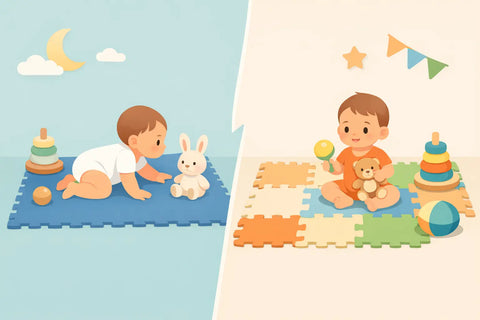
If you are choosing between a foam mat vs puzzle mat, the difference becomes very real the moment your baby starts rolling, sitting, crawling and toppling over without warning. What looks like a simple flooring decision quickly turns into a question of safety, hygiene, comfort and how well the mat fits your home.
For many parents, both options seem similar at first glance. They are soft, child-friendly alternatives to hard flooring and both are commonly used in nurseries and play areas. But once you look closer, they serve slightly different needs. The best choice depends on your baby’s age, your space, how often you clean, and whether you want a mat that feels more like part of your home rather than a temporary play setup.
Foam mat vs puzzle mat: the core difference
A foam mat usually refers to a single-piece or foldable padded surface made for cushioned baby play. It often has a more finished appearance, a smooth top layer and a consistent level of support across the full mat.
A puzzle mat is made from interlocking foam tiles. Each piece connects like a jigsaw, allowing you to build the size and shape you need. This modular design is appealing for flexible spaces, but it also changes how the mat performs in everyday family life.
That distinction matters more than it sounds. A one-piece or well-structured foam mat tends to prioritise comfort, stability and easy maintenance. A puzzle mat prioritises customisation and convenience of layout. Neither is automatically better in every home, but they do suit different priorities.
Safety should come first
When you are creating a play area for a baby or toddler, safety is the first filter. Softness alone is not enough. The mat should also feel stable under movement, stay in place well and be made from non-toxic materials.
A quality foam mat generally offers a more uniform surface. That means fewer joins, fewer edges to lift over time and less chance of tiny fingers picking at corners or seams. For babies who spend a lot of time on the floor, that smooth surface can feel more secure and easier to supervise.
Puzzle mats can still be a practical option, but the interlocking sections create multiple connection points. Over time, those edges may loosen, especially in high-use areas or homes where the tiles are frequently moved. For older toddlers this may not be a major issue, but for younger babies who explore everything with their hands and mouths, it is worth considering.
Material standards matter too. Parents should look for mats made from tested, non-toxic materials with child-safe finishes and a surface designed to be anti-slip. In a premium nursery or playpen setup, those details are not extras. They are part of what helps you shop with confidence.
Comfort for crawling, sitting and falling
A baby mat is not just for play. It becomes the place where your child learns to lift their head, push up, sit independently and crawl. At every stage, the feel under their body matters.
Foam mats are often the stronger choice for comfort because they are designed around impact absorption and long periods of floor time. A thicker, high-density foam mat can provide better cushioning against hard tile or wood flooring while still feeling supportive. That balance is important. If a mat is too soft, it can feel unstable. If it is too thin, it does not do enough when a baby topples backwards.
Puzzle mats vary more. Some are soft enough for casual play, while others feel thinner or firmer depending on the tile quality. The joins between pieces can also affect the overall feel, especially once the tiles have been assembled and reassembled a few times. You may notice slight unevenness where sections meet.
For younger babies and daily use, parents often prefer a mat with a more consistent surface and dependable cushioning. It simply feels more reassuring when your child is still unsteady.
Cleaning and hygiene in real family life
This is where many parents start with one idea and end up choosing another. A mat may look good online, but if it is awkward to clean after milk dribbles, snack crumbs or nappy-free moments, it quickly becomes frustrating.
Foam mats usually have the advantage here. A sealed surface is easier to wipe down, and because there are fewer gaps, there are fewer places for dust, crumbs and moisture to settle. In busy households, that makes a real difference. Daily cleaning feels faster and more thorough.
Puzzle mats have more seams by design. Even when they fit together well, the joins can collect dirt and require more detailed cleaning. If liquid reaches the gaps or gets underneath the tiles, you may need to lift sections and clean beneath them. That extra step is manageable, but not every parent wants to do it regularly.
In Singapore homes, where heat and humidity can already make hygiene feel like a higher priority, easy-clean surfaces are especially valuable. A mat that supports quick, practical maintenance is more likely to stay in good condition over time.
Which looks better in your home?
Nursery and play products do not need to look purely functional. Many parents want a safe play area that still suits a calm, modern interior.
Foam mats tend to offer a more polished, design-conscious finish. They are often available in soft neutral tones, subtle patterns or Scandinavian-inspired styling that blends more naturally into living rooms and nurseries. If your play area is part of your everyday home space rather than a separate playroom, that visual consistency matters.
Puzzle mats can be discreet, but they more often read as a temporary or clearly child-focused setup. Bright colours and visible seams can make them feel less refined, although some neutral versions are more understated than the old-fashioned alphabet styles many people picture first.
If aesthetics are part of your decision, a premium foam mat usually feels like the more integrated option. It supports your baby’s comfort without making the room feel cluttered or overly busy.
Foam mat vs puzzle mat for playpens
If you are using a playpen, fit becomes a major factor. A mat that leaves awkward gaps around the edges is not ideal, and neither is one that shifts too easily inside the frame.
This is one of the clearest cases where a dedicated foam mat often makes more sense. A well-sized mat designed to work with a compatible playpen creates a neater, safer result. It reduces edge gaps, provides even coverage and helps the whole play area feel intentional rather than pieced together.
Puzzle mats can be trimmed in shape by adjusting the number of tiles, which sounds convenient. But in practice, that can leave partial sections, exposed edges or a less precise fit depending on the dimensions of the playpen. The more custom the shape, the more fiddly the setup can become.
For parents building a full nursery or play zone, a coordinated system is often the easiest route. It removes guesswork and gives you confidence that each item works properly with the next.
When a puzzle mat may still be the right choice
Puzzle mats do have strengths, and for some families they are the better fit. If you need a flexible layout for an unusual corner, a temporary play zone or a budget-conscious setup, interlocking tiles can be practical. They are easy to add to, easy to remove and useful when you do not want a fixed-size mat.
They may also suit older children who need a softer floor for general play rather than a dedicated cushioned area for early development. In that case, modularity can matter more than premium finish or seamless comfort.
The trade-off is that you may give up some ease of cleaning, some visual polish and some consistency underfoot. That does not make a puzzle mat a poor option. It simply means it is better suited to certain households than others.
The better choice for most babies
For newborns, infants and early toddlers, a premium foam mat is usually the stronger long-term choice. It offers better cushioning, a more stable surface, easier cleaning and a more refined look in the home. Those benefits become especially clear if your baby spends hours each day on the floor or if you want a mat that works beautifully with a playpen or nursery furniture.
That is why many parents shopping for a dependable, safety-led setup lean towards high-density foam mats rather than modular tiles. The experience is simply more consistent, and consistency matters when your child uses the space every day.
At RaaB Family, this is exactly why thoughtfully designed baby mats remain a top choice for parents who want comfort, safety and modern styling in one purchase. A mat should not only soften the floor. It should support the way your family actually lives.
The right mat is the one that keeps your baby comfortable, your cleaning routine manageable and your home feeling calm - because the best nursery decisions are the ones that make everyday parenting just that little bit easier.