
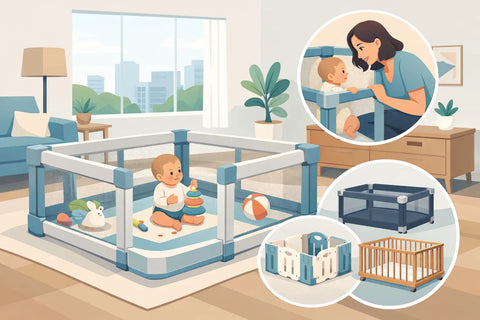
A baby playpen often earns its place in the home the moment your little one starts rolling with purpose and crawling faster than expected. One minute they are happily on a mat, the next they are aiming for table legs, power sockets, and anything that was never meant to be a toy. For many parents, the right playpen is not just about creating boundaries. It is about creating a safe, comfortable play space that works with real family life and still looks right in a modern home.
Why a baby playpen matters
A well-designed baby playpen gives parents something genuinely valuable - a secure zone where baby can play, practise movement, and explore age-appropriate toys without constant repositioning. That matters in busy households, especially in flats where living, dining, and family areas often overlap.
The best playpens support both safety and routine. They give babies a familiar play area and give parents a little breathing room to prepare a bottle, answer the door, or tidy up nearby while keeping their child in sight. That does not replace supervision, of course, but it does make day-to-day parenting more manageable.
There is also a practical design benefit. Instead of baby gear spreading across the entire room, a playpen helps define one clean, organised space for play. For families who care about aesthetics as much as function, that difference is not small.
What to look for in a baby playpen
Not all playpens are built to the same standard, and this is one category where details matter. A stylish frame alone is not enough. Parents should look closely at safety, fit, materials, and everyday usability.
Safety comes first
The first question should always be whether the playpen feels stable and secure. Panels should lock firmly, joints should be strong, and the structure should not wobble under normal movement. Babies pull themselves up, lean against the sides, and test every edge they can reach, so durability is part of safety.
Smooth finishes are equally important. You want rounded corners, no sharp protrusions, and no gaps where little fingers or limbs might get caught. If a model includes a gate panel, it should open easily for adults but remain secure against curious toddlers.
Certified safety standards also matter. For many parents, this is one of the clearest trust signals when comparing options. A playpen should be made from non-toxic materials and designed for baby use rather than adapted from general household storage or pet products.
The right size for your space
A playpen can look generous in a product image and feel surprisingly large in a living room. Before buying, think about where it will sit and how your family moves around that space every day. In compact homes, the best choice is often the one that gives baby enough room to move freely without overwhelming the room.
It also helps to think one step ahead. A younger baby may be content with a smaller area, but once crawling begins, extra play space becomes much more useful. If you want a setup that lasts beyond the earliest months, a larger format may offer better long-term value.
Some families prefer modular systems because they are easier to adapt. That flexibility can be especially useful if you plan to shift the play area between rooms or adjust the layout as your child grows.
Materials and hygiene
Babies spend a lot of time close to the floor, touching, chewing, and pressing their face against whatever surrounds them. That is why material quality should never be treated as a secondary detail.
Look for surfaces that are easy to wipe clean and designed to handle daily mess. In practice, that means dealing with snack crumbs, milk drips, sticky hands, and the occasional teething session against the rail. Materials should feel durable and hygienic, not flimsy or porous.
For many modern parents, non-toxic and eco-conscious materials are also a priority. It is a sensible one. A playpen is not just furniture. It is part of your child’s immediate environment, so reassurance around what it is made from has real value.
Why the play mat matters just as much
One mistake parents sometimes make is focusing entirely on the frame and treating the floor surface as an afterthought. In reality, the mat inside the playpen shapes the whole experience.
A supportive, high-density foam play mat helps cushion tumbles during rolling, crawling, standing, and those early, wobbly attempts at cruising. It also makes longer floor play more comfortable. Thin mats may look acceptable at first, but they often provide less shock absorption and can feel less substantial over time.
Fit matters too. A gap-free pairing between playpen and mat creates a cleaner, safer setup. When the mat is too small or poorly matched, edges can shift and leave awkward spaces. A compatible system feels neater, performs better, and tends to be easier to maintain.
For parents who want one coordinated solution, a properly matched playpen-and-mat set often makes more sense than mixing separate items and hoping they work well together.
Choosing a style that suits your home
Baby essentials do not need to look purely utilitarian. Many parents want nursery and play furniture that blends into the home rather than competing with it, and that is a reasonable expectation.
A baby playpen with clean lines, soft neutral tones, and a refined finish can sit comfortably in a contemporary living room or nursery. Scandinavian-inspired styling remains popular for good reason. It feels calm, modern, and versatile enough to work with different interiors.
That said, style should support function, not distract from it. A beautiful playpen still needs to be practical, easy to enter, easy to clean, and built for daily use. The strongest products get both sides right.
When a baby playpen is most useful
A playpen is especially useful from the stage when babies begin rolling and becoming more mobile. That usually means it comes into its own during the months when floor play is essential but the rest of the home is not fully baby-proofed for free movement.
It can also be helpful for families with older siblings. In shared spaces, a defined baby area helps keep small toys, active play, and foot traffic a bit more controlled. If grandparents or other family members visit often, a dedicated play zone can also make caregiving feel easier and more structured.
Still, it depends on your home and routine. If you have a very open, thoroughly baby-proofed room, you may use a playpen more selectively. If your layout includes hard furniture edges, decorative items within reach, or frequent household activity, a playpen may become one of the hardest-working pieces you buy.
Common buying mistakes to avoid
The most common mistake is choosing on price alone. While value matters, a cheaper playpen that feels unstable, wears badly, or lacks proper material assurance can become a false economy.
Another mistake is underestimating maintenance. If a playpen is awkward to wipe down, has too many hard-to-reach corners, or shows wear quickly, it will feel less appealing within weeks. Parents do not need products that look good only on day one. They need products that still perform after everyday family use.
It is also worth avoiding mismatched setups. A premium playpen paired with an ill-fitting, low-density mat rarely delivers the full benefit. The system should work together.
Buying with confidence
When shopping for a baby playpen, reassurance matters almost as much as the product itself. Parents want to know they are buying from a specialist brand that understands safety, comfort, and real home use - not simply listing generic baby gear online.
That is where trust signals help. Clear product information, safety-focused design, quality materials, customer reviews, and the option to view products in a showroom all make the decision easier. For families furnishing a nursery or play area, buying from a dedicated baby brand such as RaaB Family can feel far more dependable than buying from a general retailer with little category expertise.
A playpen is not the kind of item you want to second-guess after it arrives. You want it to feel sturdy, easy to live with, and right for your child from the start.
Baby playpen decisions are really about daily life
The best baby products earn their value quietly. They make routines smoother, reduce small stresses, and help parents feel more at ease at home. A baby playpen does exactly that when it is thoughtfully chosen.
If you focus on safety, material quality, mat compatibility, and a design that fits both your child and your space, you are far more likely to choose one that serves your family well beyond the early crawling months. A well-made playpen should not feel like a temporary compromise. It should feel like a smart, reassuring part of your home from the day you set it up.