
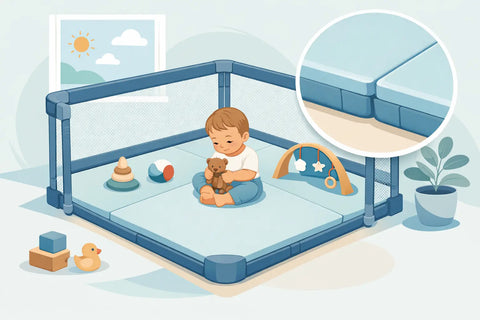
A baby does not need much space to find the one awkward edge, corner or gap in a play area. That is why a gap free playpen mat matters more than many parents expect. When the mat fits the playpen properly, the whole setup feels safer under little hands and knees, easier to keep clean, and far more comfortable for everyday play, rolling and tummy time.
For many families, a playpen is not just a baby product. It becomes part of the living room, the grandparents’ home, or the small corner of a flat that has to work hard every day. In that kind of real-life setting, fit is not a minor detail. It changes how secure the space feels and how confidently you can place your child down for independent play.
What is a gap free playpen mat?
A gap free playpen mat is a mat designed to sit neatly within the inner dimensions of a playpen, without leaving open spaces around the edges. Instead of a loose mat that shifts or leaves exposed sections, it creates a more complete cushioned surface across the base of the play area.
That sounds simple, but there is a meaningful difference between a mat that is merely placed inside a playpen and one that is made to fit it well. When gaps appear at the sides, babies can end up with hands, feet or toys pushed into those spaces. As they learn to crawl, pull up and pivot, those small openings can become surprisingly inconvenient.
A proper fit also improves the overall feel of the setup. The playpen looks tidier, the mat stays more stable, and parents do not need to keep readjusting it throughout the day.
Why a gap free playpen mat matters for safety
Safety is the first reason most parents pay attention to fit, and rightly so. Babies do not play in straight lines. They shuffle backwards, roll sideways, and test every edge they can reach. If the mat leaves a border around the frame, that area can create an uneven transition between soft foam and the firmer base or side of the pen.
A well-fitted mat helps reduce those awkward edge zones. It provides more consistent cushioning across the usable play surface, which is especially helpful during the stage when babies are learning to sit steadily, crawl with confidence, and pull themselves upright.
That said, fit alone is not the whole safety picture. The material matters too. Parents should still look for non-toxic materials, stable construction, a surface that supports grip, and foam density that cushions without feeling too soft or collapsing under weight. A thick mat can feel luxurious, but if it lacks structure, it may not offer the support babies need as they move.
This is where specialist baby brands tend to stand apart from generic options. A mat made with certified, child-safe materials and matched sizing gives parents more reassurance than a one-size-fits-all solution.
Comfort matters more than you think
If your baby spends ten minutes in the playpen once a week, almost any mat may seem acceptable. But most families use these spaces daily. They become a spot for reading board books, stacking soft blocks, supervised rest, post-bath winding down, or simply having a secure place to pop baby while you fold washing nearby.
In those everyday moments, comfort matters. High-density foam can help absorb impact from little tumbles while still feeling supportive. Babies who are learning to crawl often spend long periods on their knees and hands, so the surface should feel cushioned without becoming unstable.
There is also a comfort benefit for parents and caregivers. If you kneel inside the playpen or lean in repeatedly, a better-quality mat is easier on your own joints too. That may sound secondary, but anything that makes daily baby care more manageable tends to get more use.
A cleaner fit is easier to maintain
A gap free playpen mat also makes cleaning simpler. Crumbs, fluff, teething droplets and the usual day-to-day mess have fewer places to collect when the mat fits properly. Gaps around the edges tend to trap debris, which means more time lifting the mat, vacuuming corners and wiping hidden surfaces.
For busy households, especially in Singapore’s warm and humid environment, easy maintenance is not a luxury. It is part of keeping a baby space hygienic. Wipe-clean surfaces, antibacterial properties where applicable, and a snug fit all help the play area stay fresher with less effort.
Of course, no mat is entirely maintenance-free. Textured finishes may hold onto dust more than very smooth ones, while glossy surfaces can show marks more easily. The best choice depends on your routine and how often the playpen is used. What most parents want is a mat that cleans quickly and dries without fuss.
How to choose the right gap free playpen mat
The most important starting point is size compatibility. Measure the internal dimensions of the playpen carefully, not the outer frame. A few centimetres can make the difference between a secure fit and a frustrating one. If the mat is too small, gaps remain. If it is too large, the edges may buckle or lift.
Next, consider foam density and thickness together rather than separately. Thick mats are appealing, but density often tells you more about long-term support and durability. A thinner high-density mat can perform better than a thicker, low-quality one.
Surface texture deserves attention too. Babies need a comfortable area for crawling and play, but the finish should also be practical for wiping and resistant to everyday wear. A lightly textured anti-slip surface often strikes a good balance.
Material safety is non-negotiable. Look for mats made from non-toxic, baby-safe materials and backed by credible testing or certifications. When parents are buying for newborns and young children, reassurance should come from product standards, not just marketing language.
Finally, think about how the playpen mat fits your home. A large baby item in the middle of the living area needs to work visually as well as practically. Clean lines, calm colours and a refined finish can help the play space feel like part of the home rather than a temporary compromise.
Gap free playpen mat sets vs buying separately
There is no single right answer here, but there are trade-offs. Buying a playpen and mat as a matched set is often the simplest route because the dimensions are designed to work together. That usually means less guesswork, a neater fit and more confidence in the finished setup.
Buying separately can still work well if you already own a playpen or need a replacement mat. The key is being precise. Many parents assume mats in similar advertised sizes are interchangeable, but actual fit can vary once you account for frame shape, inner padding and construction details.
Matched systems tend to suit parents who want a straightforward purchase with fewer variables. Separate purchases may appeal if you are upgrading in stages, but they require more checking.
When a gap free fit may not be enough on its own
Even the best-fitting mat cannot compensate for a poor-quality playpen or unsuitable placement at home. If the frame wobbles, the base is uneven, or the playpen is placed near furniture edges or cords, the overall setup still needs improvement.
Age and stage matter as well. A young baby may mainly need a soft surface for supervised floor play, while an older infant pulling to stand may benefit from a firmer, more supportive mat. What works beautifully at four months may need rethinking by ten months.
This is why choosing a play space should feel like building a system, not buying a single item. The best results usually come when the mat, playpen and room layout support each other.
A better everyday play space
Parents rarely regret choosing the safer, better-fitting option for the place their child uses every day. A gap free playpen mat helps turn a basic enclosure into a more secure, more comfortable and easier-to-maintain play space - and that changes the experience for both baby and parent.
For families who want a practical setup without compromising on safety or style, it is worth choosing products designed to work together from the start. That is often where specialist nursery brands such as RaaB Family give parents real peace of mind. When the fit is right, the whole play area simply works better - and in a busy home, that kind of confidence is always welcome.